
Bitcoin Casinos in Canada 2026: How to Spot the Best Bitcoin Casino in Canada
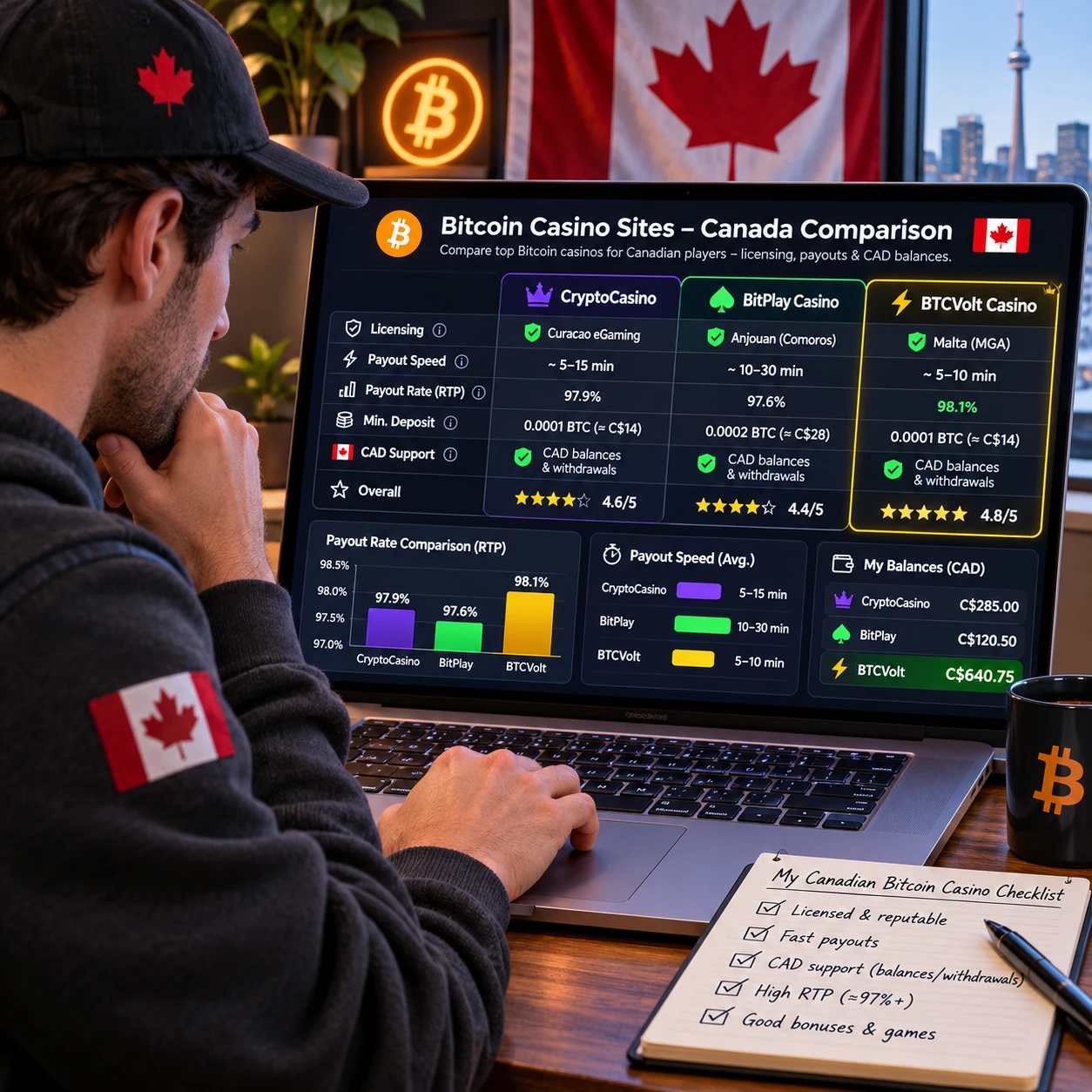
Something shifted in the Canadian crypto casino market over the last couple of years, and it shifted quietly. Back in 2022 you could still talk about 'Bitcoin casinos' like they were one thing — a scrappy alternative to the regulated sportsbooks, all of them roughly alike, all of them a bit grey. In 2026 that framing doesn't hold. The market has split into three tiers that barely resemble each other: provincially regulated operators running under iGaming Ontario, Kahnawake-licensed crypto sites that have been around since the dial-up era, and offshore brands that will happily take a Canadian deposit from a domain registered four months ago.
Problem is, every single one of them claims to be the best. Scroll any affiliate list and you'll count forty 'number one' casinos, each with a glowing score out of ten that nobody can trace back to a method. Those scores are marketing. What isn't marketing is the paperwork — the licence number in the footer, the currency your balance is denominated in, the withdrawal terms buried on page nine, and whether a complaint against the operator has anywhere real to go.
That's the whole game, really. Licensing, CAD handling, payout speed and player safety are the four levers that separate a decent Bitcoin casino from a bad one, and every one of them is checkable in a few minutes if you know where to look. By the end of this piece you should be able to size up any Canadian-facing crypto casino in under ten minutes and walk away with a straight answer.
What 'Best Bitcoin Casino in Canada' Actually Means in 2026
I'll be blunt: there's no universal winner, and any site telling you otherwise is selling something. 'Best' is player-specific. A high-roller moving five figures a month who wants BTC out within the hour is optimising for completely different things than a casual player in Mississauga who wants to deposit $50 with Interac and see a CAD balance that doesn't wobble while they play.
So instead of handing you a ranking, I'd rather hand you the criteria. Rank sites yourself and you're never dependent on somebody else's list again. That's the difference between borrowing an answer and owning the method.
The Four Pillars — Licensing, Banking, Speed, Safety
Think of these as load-bearing walls. Pull one out and the rest come down with it.
- Licensing — who authorises the operator, who audits the games, who holds the money. This is what decides whether you have any recourse at all.
- Banking — whether you can hold CAD, how crypto gets converted, and what getting funds in and out actually costs you.
- Speed — the real time from 'withdraw' to 'money in my wallet,' which is almost never the number on the marketing banner.
- Safety — provably fair or certified RNG, deposit limits, self-exclusion, and a support desk that answers with more than a copy-paste macro.
Interdependence is the part most players miss. A casino advertising 'instant Bitcoin withdrawals' is worthless if the licence offers no dispute mechanism, because the moment the payment team decides your account needs a 'routine review,' there's nobody to appeal to. Speed without accountability is just a nice animation.
Provincial Rules vs. Offshore Crypto Sites
Quick lay of the land, because this is what determines your recourse. Ontario runs a regulated iGaming market through iGaming Ontario; operators there are registered, and there's a formal complaints process via the AGCO. Outside Ontario the picture is patchier — provinces regulate different products differently, and crypto-specific rules are still catching up.
Then there's the Kahnawake Gaming Commission, a Mohawk-run regulator based in Quebec that has licensed online gaming since the late 1990s. Not a provincial regulator, no, but a real one with a real registry and a real complaints channel, and plenty of long-established crypto casinos sit under it.
And then there's everyone else: brands licensed in Curaçao, Anjouan, Costa Rica or nowhere in particular, serving Canadians entirely from outside the country. That's not automatically a scam — some of them are well run — but understand what you're giving up. In practical terms you're a customer in a foreign jurisdiction, with a foreign contract, and a dispute process that may involve emailing a regulator on another continent.
Licensing — How to Read the Fine Print
This is the part almost nobody does, and it takes about ninety seconds. Scroll to the footer. Find the licence badge. Click it.
If the badge is a static image that links nowhere, that's your answer. Real licences are verifiable — the operator publishes a licence number, and the regulator publishes a registry you can search. Malta, Kahnawake, Curaçao and most credible authorities all let you confirm that a named company holds an active licence for the specific type of gaming the site offers.
Then check the company name. The site might be called something cheerful and memorable, but the licence will be held by a corporate entity — often with a number in the name. That entity should appear in the terms and conditions as the counterparty you're contracting with. If the terms… than the licence does, treat it as a structural problem rather than a typo.
Which Authorities Carry Weight for Canadian Players
Not all licences are created equal, and the differences are practical rather than philosophical.
- Kahnawake — long history, publishes a public registry, requires player fund segregation and runs a formal dispute process. Especially relevant for Canadians because it's geographically and legally close to home.
- Malta Gaming Authority — the gold standard internationally. Audits, player protection rules, segregated funds, and an actual complaints unit. An MGA licence is expensive, which filters out the fly-by-night operators.
- Curaçao — historically light-touch, though the 2020s reforms tightened it considerably. Still the most common licence among crypto casinos. It doesn't guarantee much on its own, so look at the operator's behaviour as well as the badge.
- Newer jurisdictions — Anjouan, Tobique and similar. Cheaper to obtain, thinner oversight. Not automatic disqualifiers, but they mean you're relying on the operator's own reputation rather than external supervision.
Five Red Flags in the Footer
- No licence number anywhere on the site.
- The licence link resolves to a parked domain or a 404.
- No operating company named in the terms — just a brand name.
- The terms list a different entity than the licence holder.
- 'Licensed and regulated' with no jurisdiction specified. That phrase on its own means nothing.

CAD Deposits, Bitcoin Wallets and the Real Cost of Funding
Here's a distinction that trips up a lot of people: a CAD balance and a BTC balance aren't the same product. Some crypto casinos let you hold Canadian dollars natively and simply accept crypto as one deposit method. Others are crypto-only — every deposit converts to BTC, every balance is denominated in BTC, every bet is placed in BTC.
Both can be legitimate. But the second means you're carrying exchange-rate exposure for your entire session, and a 4% swing in Bitcoin's price during your visit moves your bankroll as much as your results do. I've watched a decent night turn into a flat one for no reason other than a red candle at 2am.
The conversion spread is where money quietly disappears. Casinos don't quote the mid-market BTC/CAD rate; they quote a rate with a margin baked in. A spread that looks like 1.5% is fine. A spread of 4–5% means every deposit and every withdrawal costs you real money before you've spun anything.
On-Ramps — Interac, Cards and Crypto Exchanges
The typical Canadian route is straightforward: buy BTC on an exchange that serves Canada, send it to the casino's wallet address, wait for confirmations. That usually means full KYC at the exchange first — ID, sometimes a selfie, sometimes proof of address — before your first purchase.
The alternative is a casino that supports Interac e-Transfer or Canadian-issued cards directly. More convenient, no exchange fees, but it usually triggers the casino's own verification requirements earlier. Either way, assume you'll be asked for ID at some point, and do it proactively rather than in the middle of a withdrawal request.
Network Fees, Confirmations and Conversion Spread
Add up the full cost before you commit:
- On-chain fee — varies with Bitcoin network congestion; can be trivial or annoying depending on the day.
- Confirmation wait — most casinos credit after one to three confirmations, which can mean ten minutes or an hour.
- Conversion spread — the gap between the real BTC/CAD rate and the casino's rate. Usually the largest of the three.
- Exchange fees — if you're buying crypto specifically to deposit, factor in the exchange's spread and withdrawal fee too.
Stack those up honestly and a 'zero fee' casino can still cost you more than one that charges a transparent deposit fee but quotes a tight rate. The headline number is rarely the real number.
Payout Speeds — What 'Instant Withdrawal' Really Promises
'Instant' almost never means instant. It means the casino doesn't impose an artificial holding period — but the money still passes through a human review queue, a blockchain, and, if you haven't verified yet, a KYC department that works business hours.
The dominant factor in real-world payout speed isn't blockchain confirmation time at all. It's whether you're pre-verified. A player who completed KYC before depositing gets paid in minutes at a good operator. A player requesting their first withdrawal at 11pm on a Saturday, unverified, may wait two days for the review alone — and then the on-chain confirmation on top of that.
Withdrawal Limits, Queues and Weekend Timing
Read the withdrawal terms before you deposit, not after. Look for the per-transaction cap, the daily and weekly caps, and whether large withdrawals need manual approval. Some casinos process in batches; a Tuesday morning request lands in the first batch, a Friday night request sits behind the weekend skeleton crew. It's not sinister, but it is real, and it's why cashout timing threads are full of contradictory experiences.
Player Safety — Provably Fair Games, Responsible Gambling and Recourse
Provably fair is a genuinely useful technology that gets routinely oversold. What it verifies: for a given bet, the outcome was determined by inputs including a seed you contributed, and the casino didn't alter the result after the fact — you can check the hash yourself. What it doesn't verify: that the game's underlying probabilities were fair to begin with, or that the house edge matches what's advertised.
So provably fair proves the outcome wasn't tampered with. It doesn't prove the maths is honest.
Independently certified RNG testing — the kind eCOGRA or a comparable lab performs — does address the maths, because it audits the payout tables against the stated return-to-player. The strongest sites do both. The weakest wave 'provably fair' around as if it's a complete safety story.
The practical safety net matters more than either one. Look for deposit limits you can set yourself, loss limits, session reminders, a self-exclusion tool that's enforced rather than decorative, and a cooling-off option. And ask where a complaint goes. Licensed operators have an ADR or regulator escalation path — the AGCO in Ontario, the Kahnawake Gaming Commission for KGC sites, the MGA's player complaints unit for Malta-licensed brands. Offshore operators with unclear licensing have nothing.
The honest difficulty is that none of this is easy to compare side by side. Every casino publishes its licensing, CAD support and payout terms in a different place, in different language, with different definitions of 'instant.' Which is exactly why I point readers toward the best bitcoin casino canada comparison resource — it pulls licensing details, CAD deposit support and withdrawal terms into one view, so you can shortlist three or four candidates in the time it would otherwise take you to audit a single site's footer.
Support Quality and Dispute Escalation
Test support before you have a problem. Ask something specific and slightly technical — the confirmation threshold for a BTC deposit, say, or the exact time zone the payments team operates in — and see whether the answer is real or a macro. Live chat that responds in thirty seconds with a canned paragraph is worse than an email desk that replies in six hours with an actual answer.
Then note the escalation path and write it down. Kahnawake-licensed, that's the KGC. Malta, the MGA. Ontario-registered, the AGCO. If there's no named regulator, there's no escalation — and that's a decision you're making before you deposit rather than after.
A Ten-Minute Checklist Before You Deposit
Run this in order. If you can't answer a line, don't deposit.
- 1. Licence number found, and verified in the regulator's public registry.
- 2. Operating company named in the terms matches the licence holder.
- 3. Balance currency confirmed — CAD or BTC, and you're comfortable with which.
- 4. Deposit and withdrawal minimums noted, plus the conversion spread.
- 5. Per-transaction and daily withdrawal caps noted.
- 6. KYC status known — verified already, or what will be required and when.
- 7. Responsible gambling tools located: deposit limits, self-exclusion, cooling-off.
- 8. Support tested with one real question.
- 9. Escalation path identified — which regulator or ADR body.
- 10. Withdrawal terms screenshotted, with the date visible.
Start with the comparison resource to build a shortlist of three, then run the checklist on each. Ten minutes per site, and you'll know more than most players ever bother to learn.
Frequently Asked Questions
Are Bitcoin casinos legal in Canada?
Online gambling is legal in Canada, and the Criminal Code framework has been read to permit it when the operator is licensed by a recognised authority. Ontario runs a formal regulated market through iGaming Ontario. Elsewhere the rules vary, and many crypto casinos serving Canadians are licensed offshore. It's legal for you to play; the regulatory protection around you differs enormously by operator.
Do I pay tax on crypto casino winnings?
Canada doesn't tax lottery-style windfalls, and casual gambling winnings are generally not taxable. But the CRA can treat gambling as business income if it's conducted in a systematic, businesslike way, and crypto disposals can trigger capital gains reporting. If your volumes are meaningful, talk to an accountant rather than a forum.
Which is faster — Interac or BTC withdrawal?
Interac e-Transfer is usually faster end-to-end, often landing within hours once approved, because it clears through the Canadian banking system rather than waiting on blockchain confirmations. BTC can be near-instant with a pre-verified account and a low-fee window, but the internal approval queue is the real variable in both cases.
Can a casino confiscate winnings over KYC?
Yes — and licensed operators generally have the contractual right to withhold funds if verification fails or terms are breached. That's why verifying before you deposit matters so much. Where a licence exists, you can dispute a decision; where it doesn't, you're relying on goodwill.
What happens if a crypto casino shuts down?
Licensed operators with segregated player funds have a process for returning balances through the regulator. Unlicensed ones simply disappear. That's the single strongest argument for checking the footer before you check the bonus.
The Bottom Line for Canadian Players in 2026
Four pillars, and they only work together: a licence you've actually verified, banking that keeps you in the currency you think in, a payout timeline grounded in pre-verification rather than marketing copy, and safety tools with an escalation path behind them.
If you only have time to check two things, check licensing and payout terms. Those are the non-negotiables. Everything else — the welcome bonus, the game library, the loyalty scheme — is negotiable, replaceable, and largely irrelevant if the first two are wrong.
One last note, and I mean it as a player rather than a writer: no casino is 'safe' in the sense of guaranteeing you come out ahead. The house edge is real and it's permanent. Safety here means transparency, accountability and a regulator who'll take your call. That's the whole bar. Clear it, play within limits you set before you log in, and treat the crypto part as plumbing rather than a promise of profit.
